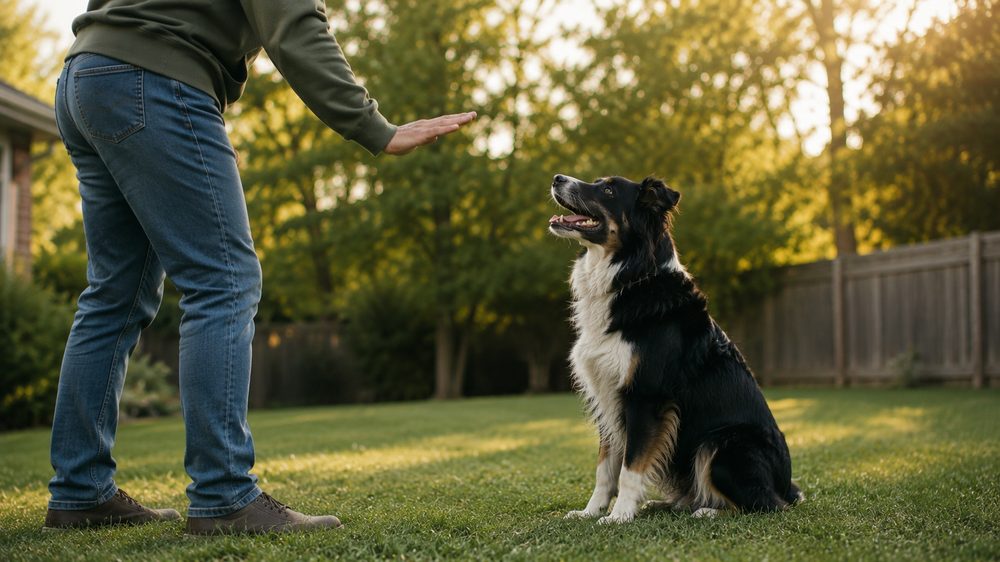
It's mid-fall, the mornings are cool, the leaves are coming down, and walking conditions are about as good as they get. But somehow every walk still feels like a negotiation. Your dog lunges forward, the leash goes tight, you stop. You've been working on loose leash walking for weeks and it still looks like this.
Here's the thing that trips up a lot of owners at this stage: somewhere along the way, you started treating every pause as a problem. Dog slows down to sniff a leaf pile? You give a gentle tug and keep moving, because stopping feels like losing ground. The result is a dog who never gets to be a dog, a walk that feels like a drill, and a leash that is still tight half the time anyway.
Letting your dog sniff is not the enemy of loose leash walking. Done right, it's one of the best tools you have.
Why dogs need to sniff (and what it has to do with the leash)
A dog's nose is doing something your eyes can't match. They're reading who's been here, what time they came through, whether that squirrel was healthy or in a hurry. Sniffing is how dogs make sense of the world, and when you cut it off entirely, you leave the dog in a state of constant unresolved curiosity.
That unresolved curiosity shows up on the leash. A dog who never gets to sniff is a dog who pulls toward every interesting smell because they've learned that forward pressure is the only way to get access to information. A dog who gets regular, structured sniff breaks has less urgency. They've already gathered some of what they need. The leash stays looser because the dog is less desperate.
Sniffing also takes genuine mental energy. A good sniff session tires a dog out in a way that another lap around the block simply doesn't. That matters for your training because a dog who's mentally satisfied is a dog who can actually focus on you.
What a decompression walk is (and how it differs from a training walk)
A decompression walk is not a failed training walk. It's a different thing entirely, with a different goal.
On a training walk, you're working on loose leash mechanics. The dog is in a closer zone, you're asking for attention, you're rewarding the right position, and you're managing the environment to set the dog up to succeed. That takes focus from both of you.
A decompression walk is lower stakes on purpose. You follow the dog's nose. You go slow. You let them zigzag and double back and stand still for ninety seconds sniffing a fence post. The goal is not loose leash walking. The goal is to let the dog be a dog.
Both walks matter. A dog who only ever gets training walks burns out and starts associating walks with pressure. A dog who only ever gets decompression walks doesn't build the skills to walk nicely on a busy street. The sweet spot is knowing which walk you're on and committing to it.
How to build a sniff cue that gives you both some control
You do not have to choose between training and sniffing on every single walk. A sniff cue lets you open and close sniff time so the dog is not left guessing.
The idea is simple. Pick a word or short phrase you'll use consistently, something like "go sniff" or "free time." When you give the cue, the leash goes long and the dog gets to explore. When you cue something like "let's go," you're back to your loose leash work. Over time the dog learns the pattern: focused walking earns sniff breaks, and sniff breaks have a clear end point.
This removes a lot of the conflict. The dog is not pulling toward every smell because they know a break is coming. You're not tensing up every time they slow down because you've built a structure around it. The sniff break is not a failure of the walk. It's the plan.
To build this, start on low-distraction routes. Give the cue clearly, let the dog sniff freely for a minute or two, then cue the return to walking and reward the transition. Keep early sessions short. You're building a communication habit, not running a marathon.
How to structure a single walk that does both
A practical structure for a training walk with sniff breaks built in looks something like this:
- Start with a loose leash segment. Pick a short stretch, maybe a block, and work on the mechanics. Reward generously for the right position. Keep moving.
- End the segment with your sniff cue. Let the dog decompress for a minute or two at a spot they're interested in. This is the reward for the working stretch, not a separate activity bolted on.
- Cue the return to walking. Reward the transition. Start another loose leash segment.
You are not doing this to be rigid. You're doing it because the structure tells the dog what's expected and when. That clarity is what actually builds loose leash skills. A walk where anything might happen at any moment is harder for a dog to learn from than a walk with a predictable rhythm.
Why a long line in an open space beats another lap of the block
If your dog is in a high-arousal phase, tight city blocks full of triggers are a hard environment to train in. Sometimes the most productive thing you can do is take the dog somewhere open and put them on a 20- to 30-foot long line.
A long line gives the dog enough range to cover ground, follow a scent trail, and decompress properly, without you losing control. For a dog who has been doing a lot of structured walking, a long line session in an open park is genuinely restorative. It also gives you a chance to observe the dog moving freely, which tells you a lot about what they're actually looking for on walks.
This is not giving up on training. It's recognizing that a dog who gets enough unstructured movement and sniffing is a calmer, more trainable dog when you do ask for focus.
Sniffing versus pulling toward a distraction
These two things can look similar and they are not the same. Sniffing is exploratory and relatively calm. The dog's body is loose, they're moving slowly, they're taking in information. Pulling toward a distraction is a different state entirely. The body is forward and tight, the dog is fixated, and there is no sniffing happening yet. They haven't reached the thing.
In the second case, a sniff break won't help in that moment. You're dealing with a focus and threshold issue, not a sniff deficit. The fix there involves distance and management, getting the dog far enough from the distraction that they can think, then rewarding check-ins with you.
Knowing the difference lets you respond to what's actually happening rather than applying the same answer to every situation.
The bottom line
Your dog is not pulling to be difficult. They're pulling because they're under-informed and over-contained. Regular, structured sniff breaks built into your walks are not a detour from loose leash walking progress. They're part of what gets you there.
This fall, with the cool air and all those interesting leaf-pile smells, is actually a great time to experiment with this. Pick one walk this week. Build in three proper sniff breaks with a clear cue. See what the rest of the walk looks like.
Your dog deserves to use their nose. 🐾