A chicken bone on the sidewalk. A dropped pill. Something unspeakable your dog found in the grass. "Leave it" is the cue that can genuinely save your dog's life, and it works even on dogs who treat every walk like an all-you-can-eat buffet. Here's how to teach it from scratch.
What "leave it" really means
"Leave it" isn't "drop the thing in your mouth" - that's a different cue, usually "drop it." "Leave it" means "don't make contact with that in the first place." You're teaching your dog to disengage from something before they grab it, which is exactly what you need when they spot something dangerous on the ground.
The deeper skill underneath it is impulse control: the ability to want something and choose not to take it because something better comes from listening to you. That's a muscle you build, and "leave it" is a great way to build it.
The core method
The whole technique rests on one elegant idea: your dog learns that ignoring the thing they want gets them something better than the thing they wanted. Here's the progression.
Stage 1: The closed fist
Put a boring treat in your closed fist and present it to your dog. They'll sniff, lick, paw, maybe nibble at your hand trying to get it. Just wait. The instant they stop and pull back - even for a second - mark it ("yes!") and reward from your other hand with a better treat.
Read that again: they never get the treat they were pestering. They get a better one from the other hand, for choosing to disengage. That's the entire concept in miniature. Repeat until your dog backs off the fist quickly.
Stage 2: Add the words and the open hand
Now introduce the cue. Say "leave it" as you present the closed fist. Once your dog reliably backs off, level up by opening your hand flat with the treat exposed. If they go for it, close your hand. They only earn the reward (from the other hand) for leaving the open treat alone. This is harder - the temptation is visible now - so be patient.
Stage 3: Treat on the floor
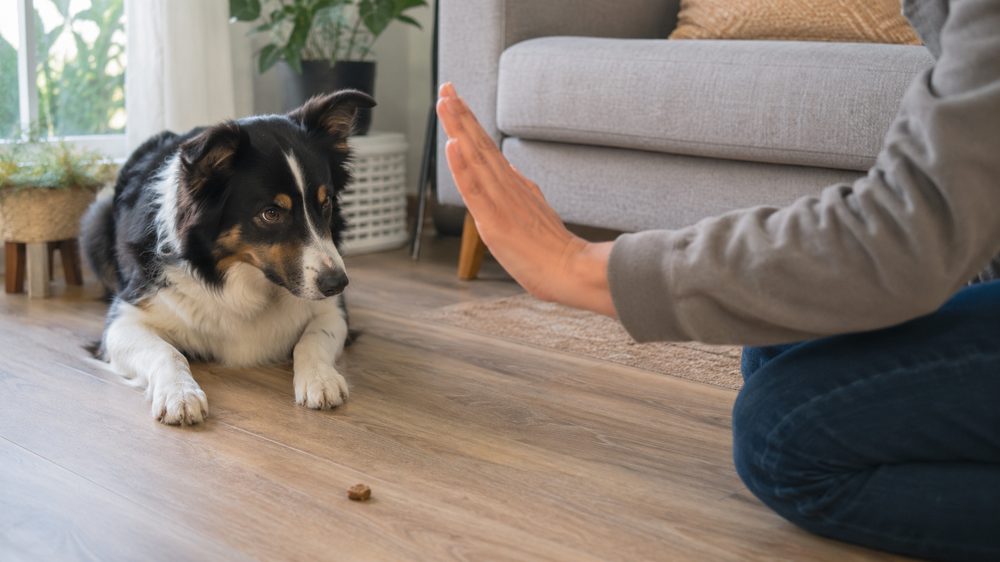
Place a treat on the floor and cover it with your hand or foot, ready to block. Say "leave it." Reward disengagement from your hand. Gradually expose more of the treat, then work up to leaving it uncovered on the floor while your dog holds back. You're getting closer to the real-world scenario.
Stage 4: Movement and the real world
Practice walking past treats on the floor. Drop a treat and cue "leave it" as you keep moving. Then take it on the road - around dropped food, other dogs, interesting smells. Lower your expectations when you raise the difficulty: a distracting park is far harder than your living room, so reward generously when you add real-world temptation.
The food-obsessed dog
If your dog is intensely food-motivated, you might think "leave it" is hopeless. It's actually the opposite - their love of food is the lever. The reason "leave it" works is that you're trading up. A dog who desperately wants the floor treat learns that the treat in your hand is even better and comes guaranteed when they listen. For a foodie, that's a deal worth taking. You just need higher-value rewards (real meat, cheese) to outbid the temptation, and more reps to build the habit.
Common mistakes
Letting them get the forbidden item. If your dog ever succeeds in snatching the thing you said "leave it" about, you've taught them that persistence pays. Set up so you can always block, especially early on.
Rewarding from the wrong hand. The reward should never be the item they were told to leave. Always pay from the other hand, with something better. This keeps "leave it" meaning "disengage," not "wait and you'll get it anyway."
Jumping ahead. Open hand before the closed fist is solid, floor before the hand is reliable - rushing the stages just produces failures. Each stage should be easy before you advance.
Only practicing with treats. Generalize it. Practice "leave it" with toys, with the cat, with that spot on the walk where the trash always is. The cue should mean the same thing regardless of what it's pointed at.
The bottom line
"Leave it" is built one small choice at a time: your dog wants something, chooses to disengage, and discovers that listening to you pays better than grabbing. Start with the closed fist today, move through the stages only as each gets easy, and use high-value rewards for your foodie. Done right, you'll end up with a dog who can spot a dropped pill on the kitchen floor and look up at you instead - which, one day, might be the most important thing they ever learned.