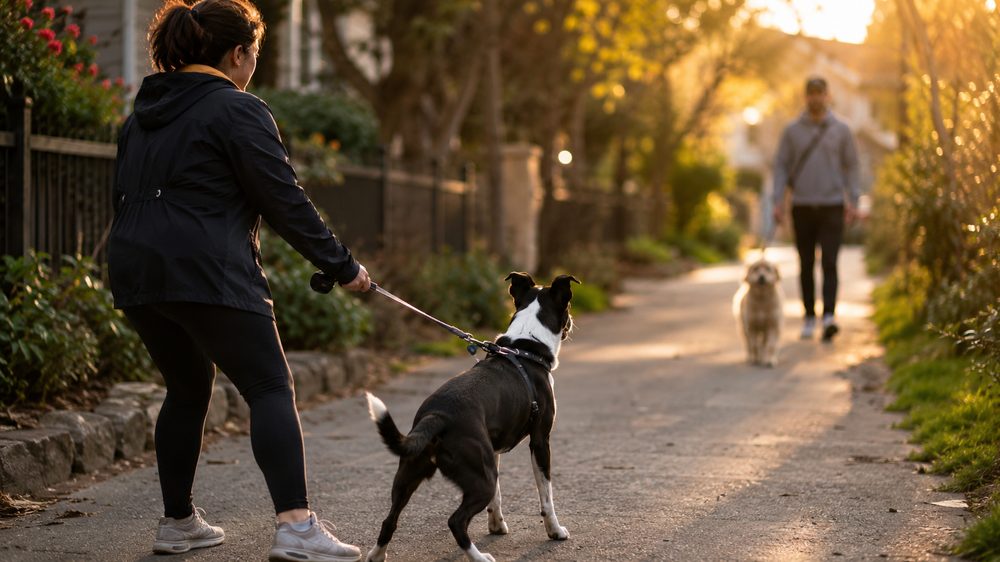
The walk that worked fine in August looks completely different in October. Same neighborhood, same dog, same route. But now it's dark by the time you clip the leash on, headlights sweep across the sidewalk every two minutes, and your dog, who was doing so well with loose-leash work, is suddenly pulling again like none of that ever happened.
Nothing broke. The conditions just changed. Here's how to walk confidently after dark without overhauling everything you've already built.
Why low light changes your dog's behavior
Before you fix anything, it helps to understand what's actually happening. Dogs lean heavily on vision to make sense of what they're hearing. In daylight, a rustle in the bushes gets a glance, a quick sniff, and then your dog moves on. At night, they hear it but can't fully see it, and that gap between the sound and the picture is where arousal spikes.
A dog that pulls harder after dark is not being bad. They're managing uncertainty. The sudden shape of a cyclist, the sound of a skateboard before it rolls into a pool of streetlight, a cat that appears out of nowhere. Their threshold for reacting is lower because they have less time to process what's coming.
That's the context for everything else in this post.
Being seen: what actually works
Drivers and cyclists are not looking for dogs. They're looking for people-sized objects. A reflective collar on a dog walking at knee height, partly hidden by a bumper or a parked van, may not register until it's too late. Visibility is a layered problem.
For your dog: a reflective vest or harness, not just a collar, gives drivers a much larger surface to spot. LED clip-on lights that face outward are even better, because active light is visible from farther away than passive reflection. Reflective material only works when a light source hits it directly. LED gear works in all conditions.
For you: this matters as much as the dog. A driver who sees a person is already looking in the right zone to see the dog on the leash. Reflective strips on a jacket or a running vest are a start. A headlamp or handheld flashlight does double duty: it makes you visible, and it lets you see what your dog is reacting to before they fully react.
One practical note: avoid walking between a bright light source and traffic. If you're lit from behind, you look like a silhouette to anyone approaching. Stay where you can be seen, not just where you can see.
Keeping loose-leash work intact after dark
If your dog has been making progress with loose-leash walking, night walks will test it. That's not a setback. It's just a harder training environment. The skills transfer, but you have to hold them more deliberately.
A few things that help:
- Shorten your working length. You don't need a shorter leash, but keeping more of it gathered in your hand means less lag between a lunge starting and your response. Not a stranglehold, just a tighter working length so you stay connected.
- Mark and reward focus more often. In daylight your dog can see the next ten seconds of the walk. At night, everything is closer and more sudden. Rewarding eye contact and check-ins keeps their attention cycling back to you instead of locked forward into the dark.
- Don't wait for the pull. If your dog's body stiffens, ears go up, or pace shifts, that's the moment to redirect. Say their name, change direction, offer a treat at your side. You're working in the gap between noticing and reacting, and at night that gap is shorter, so your timing needs to be sharper.
If your dog is more reactive on every single night walk, that's worth acknowledging. A dog that is genuinely overwhelmed won't retain much training. Shorter routes in quieter areas until things settle is not a step backward. It's working at the level that's actually productive.
What to do when your dog spooks
It happens to every dog. A trash bag moves in the wind. A kid on a bike comes out of nowhere. Your dog hits the end of the leash hard enough to nearly pull you over.
The goal in that moment is not to correct. It's to reset. Stop moving. Let the leash go slack if you can do it safely. Talk in a normal, calm voice and wait for your dog's breathing to settle before asking them to move again. Trying to keep walking while they're still in full alarm mode is asking them to learn something when they're not capable of learning anything.
If spooks are frequent or intense, keep a high-value treat in your pocket that only comes out on night walks. The goal is not to bribe away fear. It's to give your dog something familiar and good to orient toward when the environment stops making sense.
Route choices that make everything easier
Where you walk matters as much as how you walk. Well-lit streets with predictable traffic are genuinely easier for your dog to process than a dark park where anything could be anywhere. A shorter route in good lighting is better training ground than a longer one in the dark, even if the longer one is your usual walk.
Give yourself a buffer from the road edge, and where there's no sidewalk, walk facing oncoming traffic so you can see what's coming. If you wear wireless earbuds, leave one ear free. You need to hear what your dog is about to react to.
Know your local leash laws, too. Being leashed and visible is also basic courtesy to other walkers who may not want to meet your dog without warning in the dark.
A quick gear summary, without the shopping list
You don't need much:
- A light-up or reflective harness that wraps your dog's torso
- A small LED clip-on light, facing outward, as backup
- A headlamp for you, or a flashlight for your free hand
- High-value treats in a pocket you can open one-handed
That covers visibility, safety, and training in one kit that fits in a jacket.
The walk is still worth taking
Long summer evenings were a gift, and you used them. Early sunsets just mean adjusting, not stopping. Your dog still needs the walk, still benefits from the training reps, and still wants to be out there with you. The dark adds variables, not danger, as long as you account for them.
Be seen. Expect your dog's threshold to be lower. Hold your training a little tighter. And keep going. 🐾