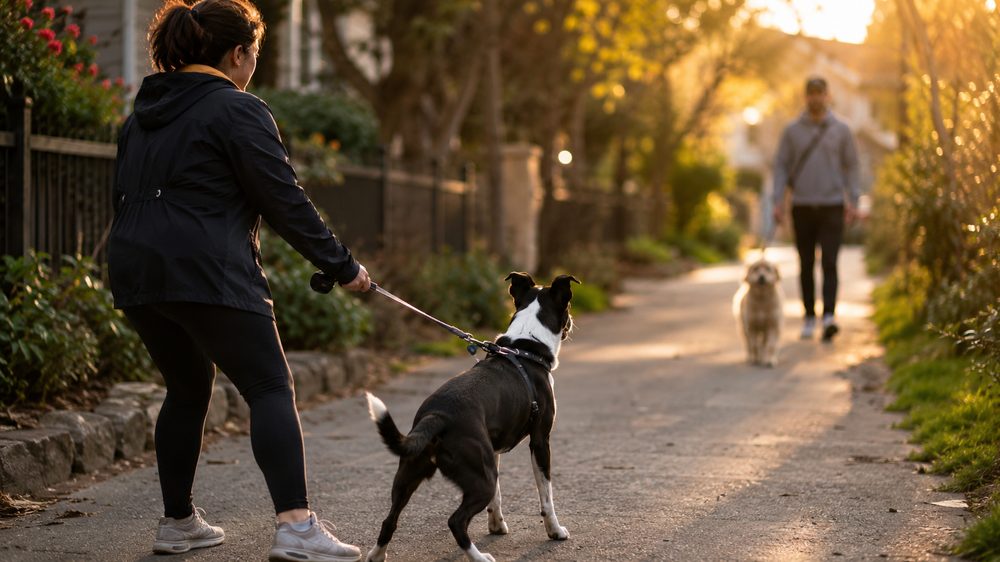
Your dog turns into a lunging, barking tornado the second another dog appears, and you've started planning walks like a covert operation. Leash reactivity is exhausting and embarrassing - and it's also one of the most fixable behavior problems out there, once you understand what's actually driving it.
Reactivity is not aggression
This is the reframe that changes everything. A reactive dog usually isn't trying to start a fight. They're having an outsized emotional reaction - most often frustration or fear - that they can't regulate, made worse by being trapped on a leash with nowhere to go. The barking and lunging is the overflow, not a battle plan.
That distinction matters because it points to the fix. You don't correct your way out of an emotion. You change how the dog feels about the trigger, and the behavior follows.
Why the leash makes it worse
Off-leash, a dog who's unsure about another dog has options: approach in an arc, sniff, retreat, look away. The leash deletes all of that. Now they can't create distance, can't move naturally, and often can't even see clearly past your legs. That trapped feeling cranks up the intensity. Add the way we instinctively tighten the leash when we spot a trigger - which telegraphs our own tension straight down the line - and you've built a feedback loop.
Understanding threshold
The single most important concept for fixing reactivity is threshold: the point at which your dog tips from "aware but coping" into "over it and reacting." Below threshold, your dog can see the trigger and still think, eat, and respond to you. Above threshold, the thinking brain goes offline and no amount of treats or cues will land.
Almost all reactivity training happens below threshold. If your dog is already lunging, you're not training - you're managing damage. The entire game is keeping enough distance that your dog stays in the workable zone, then gradually shrinking that distance over weeks.
The 4-week plan
This is a starting framework, not a guarantee - some dogs move faster, some need a trainer's hands-on help. But it's a real, ordered progression you can begin this week.
Week 1: Foundation and engagement, no triggers
Before you face the scary stuff, build the tools. In calm, trigger-free spaces, teach a rock-solid "find it" (toss a treat to the ground) and a reliable name response that snaps your dog's attention to you. Pay generously. You're building an attention habit you can later borrow under pressure. Practice the mechanics of feeding fast and often while walking, so it's smooth when it counts.
Also this week: get your gear right. A well-fitted harness with a front clip gives you better control without choking, and a standard six-foot leash beats a retractable for this work. Stop walking your dog in places that reliably blow past threshold - every full reaction sets you back, so management starts now.
Week 2: Find your threshold distance
Now you introduce triggers at a distance where your dog notices but stays under threshold - this might be across a wide park, or half a block away. The instant your dog sees the trigger, start feeding. The sequence you're building: trigger appears, good things rain down. Trigger leaves, the buffet closes.
This is classical conditioning, and it's doing something subtle but powerful: it's rewiring "other dog = tension" into "other dog = my person turns into a treat dispenser." You're not asking for obedience yet. You're changing the emotional association. Find the distance where your dog can take treats calmly, and work there. If they won't eat, you're too close - back up.
Week 3: Add the pattern and shrink distance
Once your dog reliably looks at a distant trigger and then back at you for the treat - that voluntary check-in is the behavior you want - you can start closing distance slightly. Emphasis on slightly. Shrink the gap a few feet at a time across multiple sessions, and only when your dog is succeeding consistently at the current distance.
This is also where you can introduce a "let's go" cue - a cheerful turn-and-move-away that gives your dog a productive exit instead of a reaction. Reactive dogs feel better when they learn they can leave. You're handing back the option the leash took away.
Week 4: Generalize and stress-test
Behavior that works on your quiet practice street won't automatically transfer to a busy sidewalk. Week 4 is about repeating the earlier work in new locations, at new times, with different types of triggers. Each new context is partly a fresh start, so drop back to a comfortable distance when you change the setting, then rebuild.
By now you should be seeing the pattern: your dog spots a trigger and, instead of erupting, looks to you. That look is gold. It means the thinking brain stayed online. Reward it every time, because it's the foundation everything else is built on.
Common mistakes that stall progress
Working too close. The most common error by far. If your dog is reacting, you're over threshold and no learning is happening. Distance is your most powerful tool - use more of it than you think you need.
Punishing the reaction. Correcting a fearful or frustrated dog for reacting often deepens the negative association with other dogs. Now the trigger predicts both the scary dog and a leash pop. You've made it worse.
Going too fast. Shrinking distance before your dog is ready guarantees reactions, which set you back. Slow is fast here.
Inconsistent gear and handling. Tightening the leash, holding your breath, and bracing all signal danger to your dog. Practice keeping your hands and breathing relaxed - your calm is part of the training.
When to get a pro
If your dog's reactivity includes genuine aggression, has a bite history, or simply isn't budging with consistent work, bring in a certified trainer or a veterinary behaviorist. Some reactivity has a fear or anxiety component significant enough that medication, alongside training, makes the behavioral work possible. That's not failure - it's using every tool available to help a struggling dog.
The bottom line
Reactivity feels like a character flaw and is really an emotional regulation problem - which means it responds to patient, distance-aware training that changes how your dog feels rather than just what they do. Stay under threshold, pair triggers with great things, shrink distance slowly, and protect every win. The tornado on the end of your leash can absolutely become a dog who glances at another dog and then looks to you. Thousands of dogs have made exactly that trip.