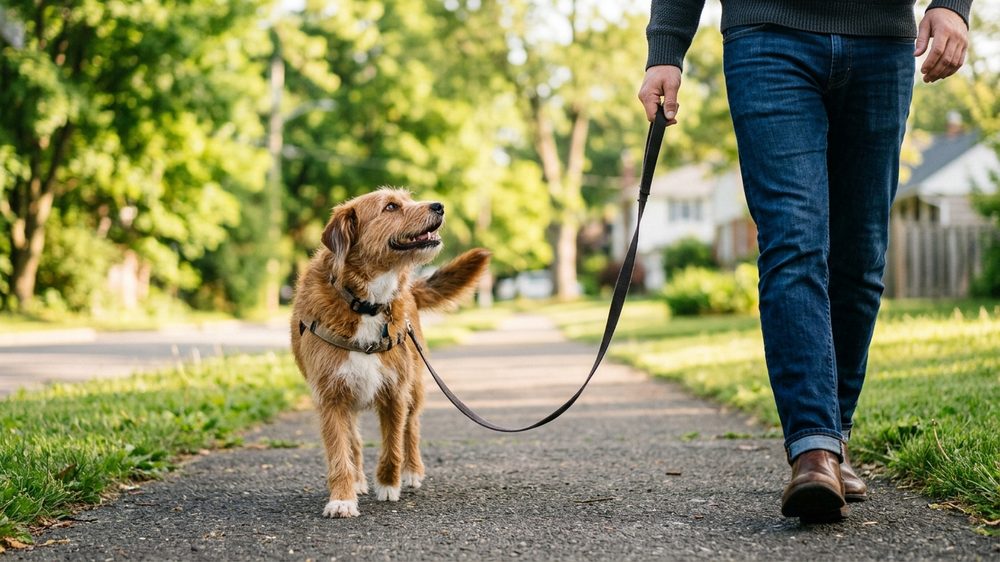
You headed out for a nice walk. Your dog had other plans. Now you're being towed down the street like a water skier who lost the boat. Sound familiar?
Leash pulling is one of the most common things dog owners struggle with, and here's the good news: it is not a personality flaw in your dog. It is a training gap. A very fixable one.
This guide walks you through why dogs pull, how to teach loose-leash walking using positive reinforcement, the right gear to support your training, and what to do when progress feels slow.
Let's get into it.
Why Dogs Pull on the Leash
Dogs pull because it works. That is genuinely the whole story.
Your dog gets excited, surges forward, and you follow. Walk continues, dog gets what it wanted. Repeat a few hundred times and you have a dog that has learned pulling is the most efficient way to move through the world.
There is no dominance happening here. No attitude. Just a very logical animal doing what has reliably worked. Young dogs and high-energy breeds tend to be the worst offenders simply because their enthusiasm outpaces their self-control, but any dog can learn to pull if the pattern is allowed to stick.
The fix is to change the equation: pulling never works, and a loose leash always does.
What You Will Need Before You Start
Front-clip harness. This is the single most useful piece of gear for a dog who pulls. When the leash attaches at the chest, forward momentum steers the dog sideways rather than forward. It does not fix pulling on its own, but it makes training significantly easier and reduces strain on both of you while you work through it.
Head collar. For very strong dogs or owners who need immediate mechanical help, a head collar (like a Halti or Gentle Leader) can be effective. It does take some getting used to and should always be introduced gradually with positive association. Not every dog tolerates them, so keep that in mind.
High-value treats. You want something your dog genuinely finds exciting. Soft, small, and smelly. Kibble from the bowl is unlikely to compete with the scent of every dog in the neighborhood. Think small pieces of cooked chicken, cheese, or a good training treat.
A standard 6-foot leash. Leave the retractable leash in the closet for now. Retractable leashes teach dogs that pulling extends their range, which is the exact opposite of what you are trying to achieve.
The Core Method: Stop-and-Go
This is the foundation of loose-leash walking and it is beautifully simple.
The moment your dog hits the end of the leash and tension appears, you stop. Completely. Feet planted, no drama, no yelling.
Wait. Your dog will eventually turn to check why you have stopped, step back toward you, or simply pause. The second that leash goes slack, you mark it (a clipped "yes" or a clicker) and you move forward again.
Pulling stops all movement. A loose leash means the walk continues.
This takes patience. The first few sessions you might travel half a block in ten minutes. That is fine. You are not trying to get somewhere; you are teaching a concept.
Once your dog starts to get it, layer in rewards for actively walking near you. When they glance up at you while walking on a loose leash, treat that moment like it is the best thing they have ever done. Because in training terms, it genuinely is.
Changing Direction
This one pairs well with stop-and-go once your dog has the basic idea.
When your dog starts pulling, instead of stopping, turn and walk in the opposite direction. Calmly, no jerking, no fuss. Your dog now has to catch up to you, and when they do and the leash is loose, reward them.
The unpredictability of this method keeps dogs paying attention to you rather than just charging ahead. You become more interesting than whatever is at the end of the street.
Rewarding Calm Walking
This is the part most people forget. They only react to pulling and never reward the good stuff.
Mark and treat your dog regularly for walking near you with a loose leash. Especially in the early stages, this should happen every few steps. You are building a picture in your dog's mind: being near you, with slack in that leash, is where all the good things happen.
Over time, you can stretch out the rewards as the behavior becomes more reliable. But start generous.
Common Mistakes That Slow Progress
- Skipping sessions when the dog pulls too much. Inconsistency is the biggest enemy here. If pulling works on some walks and not others, the lesson never lands.
- Using aversive corrections like leash jerks. Beyond being uncomfortable for your dog, they add stress and confusion to an already overstimulating environment. Positive reinforcement works. Stick with it.
- Going straight to busy, distracting environments. Start in your front yard or a quiet street. Proof the behavior in easy settings before asking for it around squirrels, other dogs, and the chaos of a main road.
- Expecting overnight results. Most dogs need several weeks of consistent practice before loose-leash walking starts to feel natural to them. Some take longer. That is not failure; that is just how behavior change works.
Troubleshooting for Stubborn Pullers
Some dogs are exceptionally motivated pullers, particularly working breeds, sighthounds, and any dog who has been reinforcing the habit for years.
For these dogs, go back to basics in a very low-distraction environment. A quiet hallway indoors if needed. Build the skill in tiny, boring settings where your dog can actually think, then gradually add distractions over time.
Consider shorter, more frequent training sessions rather than one long walk. Five minutes of focused loose-leash practice twice a day often beats one frustrating thirty-minute walk.
For very large or strong dogs where safety is a genuine concern, a front-clip harness combined with a double-clip leash (attaching to both the front and back rings) gives you more control while you work on the training side.
A Note on Different Sizes and Temperaments
Small dogs can pull just as persistently as large ones and should go through the same training process. The mechanics are just a bit less physically demanding for the human involved.
Anxious or easily overwhelmed dogs may pull toward home or away from things that worry them. If the pulling has a fear component rather than pure excitement, the approach needs to account for that emotional state.
The Bottom Line
Loose-leash walking is a skill, not a personality trait your dog either has or doesn't. It takes repetition, consistency, and a willingness to invest some boring practice sessions before the payoff shows up on real walks.
But when it clicks? Walks go from a tug-of-war to one of the best parts of both your days.
Start in your front yard today. Plant your feet the moment that leash goes tight. Treat the slack. Be boring when they pull and brilliant when they walk nicely. That is genuinely it.
Because Google doesn't have a dog. But you do, and you have got this. 🐾