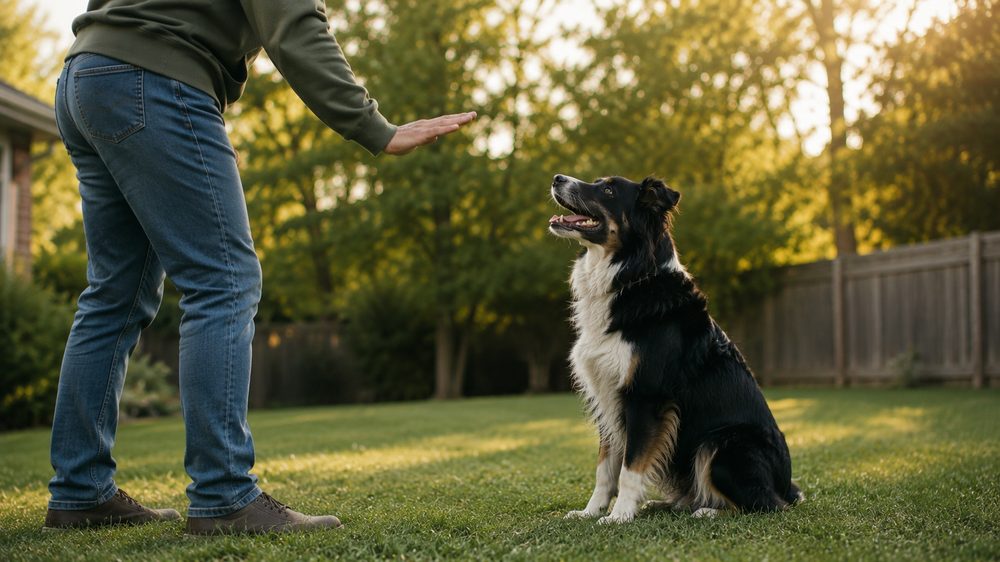
If you've ever been told to "show your dog who's boss," you've been handed advice that the science quietly retired years ago. Here's what actually happens in a dog's brain when you train with rewards versus corrections, and why one builds a partner while the other builds a problem.
What positive reinforcement actually means
Positive reinforcement is simple to define and easy to fumble. You add something the dog values - a treat, praise, a game of tug - immediately after a behavior you want to see again. That's it. The "positive" doesn't mean upbeat or gentle. It means you're adding something. The reinforcement means the behavior gets stronger because of it.
The fumble usually happens in the timing. Reinforcement that lands two seconds late isn't rewarding the sit, it's rewarding whatever your dog did two seconds later. We'll come back to that, because it's the single biggest thing separating dogs who "get it" from dogs who seem stubborn.
Why punishment backfires
Punishment can absolutely suppress a behavior in the moment. Yell loud enough and a dog will stop barking. The problem is what else it does. Decades of behavioral research point to the same conclusion: aversive methods raise a dog's stress, fear, and anxiety, and those side effects don't stay neatly contained to the behavior you were targeting.
A dog corrected harshly for growling, for example, often learns to skip the growl entirely and go straight to a bite, because the warning got punished. You didn't fix the aggression. You deleted the early-warning system. That's the central danger of punishment: it changes the symptom without touching the cause, and it frequently makes the underlying emotion worse.
There's also the relationship cost. Dogs trained primarily through corrections tend to show more avoidance of their handlers and more conflicted body language. The dog isn't working with you. It's working to avoid you being upset, which is a fundamentally different and more fragile thing.
What's happening in the brain
When a dog earns a reward, the brain releases dopamine, and dopamine doesn't just feel good - it tags the preceding behavior as worth repeating. You're not bribing your dog. You're giving the brain the exact chemical signal it uses to build habits. Repeat the loop enough times and the behavior becomes automatic, no treat required.
Fear-based learning runs on a different system, one built around the amygdala and threat detection. It learns fast, which is why punishment can look effective. But threat-based learning is rigid, context-specific, and prone to generalizing in unhelpful ways. A dog that learns "the living room is where scary corrections happen" may simply become anxious in the living room.
How to actually do it well
Good reinforcement training comes down to a few mechanics most people never get taught.
Mark the moment. Use a consistent marker - a clicker, or a crisp word like "yes" - the instant the behavior happens. The marker bridges the gap between the behavior and the treat that arrives a second later. Without it, your timing has to be superhuman. With it, you have a tool that says "that, right there, is what earned this."
Pay well at first, then taper. When a behavior is brand new, reward every single time. Once it's reliable, shift to rewarding intermittently. Counterintuitively, this makes the behavior stronger, the same way a slot machine keeps people pulling the lever. Predictable rewards build behaviors; unpredictable rewards maintain them.
Keep sessions short. Five minutes, several times a day, beats one marathon session. Dogs consolidate learning during rest, so frequent short reps with breaks outperform long grinds.
Raise difficulty one variable at a time. A dog that sits perfectly in your kitchen may completely blank in a busy park. That's not defiance, it's the difficulty jumping on three axes at once - distraction, location, and distance. Change one thing at a time.
The bottom line
You're not choosing between being "firm" and being "soft." You're choosing between a method that builds a confident, willing dog and one that suppresses symptoms while quietly raising the emotional temperature. The research has been pointing the same direction for a long time. Reward the behavior you want, mark it precisely, and let your dog's own brain chemistry do the heavy lifting.