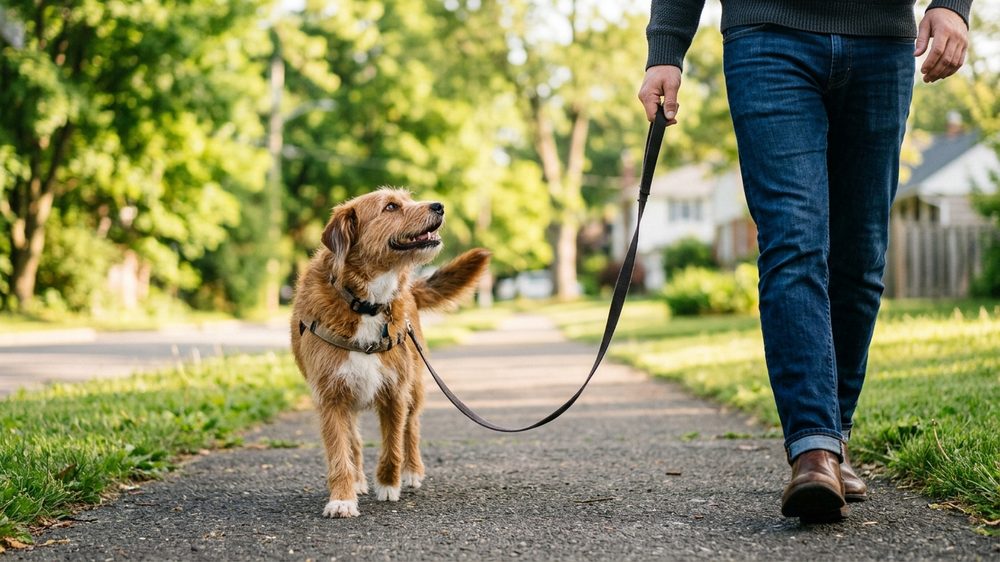
Your first dog was coming along beautifully. Loose leash, decent focus, manageable on the street. Then dog number two arrived, you clipped both leashes to your hand, and suddenly you're plowing down the sidewalk like a sled team missing the sled.
This is not a training failure. It is a context failure. And there is a real difference.
Walking two dogs at once is not the same as two single walks happening side by side. It is a new skill for everyone involved, including your first dog. The good news is the foundation you already built is not gone. It just needs some rebuilding in a new setting. Here is how to do that without starting from scratch.
Why your trained dog regresses
This is the question most people don't stop to ask. You trained dog one. Why is dog one suddenly yanking again?
Because dogs are not generalizing machines. A skill learned in one context does not automatically transfer to a new one. Your dog learned loose leash walking with you, one-on-one, in familiar conditions. The moment a second dog enters the picture, the arousal level changes, the attention shifts, and the rules feel different because the whole experience feels different.
Your first dog is not being stubborn. They are genuinely working in a new situation that happens to look like the old one.
This matters because the fix is not just training the new dog. You have to retrain the pairing.
Walk them separately first, every time
Before you ever attempt walking multiple dogs together, both dogs need solid individual loose leash skills. Not perfect. Solid. That means each dog can hold a loose leash for most of a walk, in most conditions, without constant correction.
If dog two is still in early training, keep them separate until they get there. Rushing the pairing does not save time. It costs you weeks of cleanup work later.
What those solo walks buy you is more than just skill. They give you a clear picture of each dog's trigger points, pace preferences, and focus ceiling. You will need that information when you merge them.
Why a coupler usually makes things worse
The instinct when walking two dogs is to grab a coupler and clip both dogs to a single leash. One hand, one line, sorted.
In practice, couplers tend to create problems faster than they solve them. When one dog lunges, the other gets yanked. When one dog wants to sniff left and the other wants to go right, they are fighting geometry instead of walking. A dog who is being pulled sideways by their companion is not in a headspace to hold a loose leash.
Two separate leashes, one in each hand, give you independent control. You can correct one dog without affecting the other. You can manage different paces. You can step between them if needed.
Yes, it requires more coordination. That coordination is actually the skill you are building.
Which side each dog walks on
Pick a side for each dog and hold it every single walk. Consistency here matters more than which side you choose. Left dog stays left, right dog stays right. Every time.
Why it matters: dogs learn position as part of the walking behavior. When position shifts around, the whole structure feels looser, and loose structure invites loose behavior.
In the early weeks of walking two dogs together, keep the leashes short enough to maintain position but not so tight you are creating tension. You want the leash relaxed with structure, not slack with chaos.
If one dog tends to drift across your path toward the other, that is the dog you spend more solo practice time with before the next paired walk.
When one dog reacts and the other feeds off it
This is the hardest part of walking multiple dogs. One dog spots a squirrel, lunges, and suddenly the second dog is spinning and barking at nothing in particular but absolutely committed to the energy.
Your job in that moment is triage. Get the reacting dog refocused first. A u-turn, a stop, a name cue, whatever works for that dog individually. Then check dog two. Often they will settle once the first dog settles. The arousal feeds in one direction.
The mistake is trying to manage both dogs simultaneously in the middle of a reaction. You end up managing neither.
Practice threshold work. Know where each dog starts to drift before a full reaction. Work below that line in paired walks until the threshold rises. This takes time and it is worth every walk.
Managing size and energy differences
A 15-pound terrier and a 70-pound Lab going for a walk together is a genuine coordination puzzle. Different stride lengths, different pace needs, different trigger points.
A few things that help: let the slower or lower-energy dog set the base pace when the situation allows. High-energy dogs can walk more with one-on-one time before the paired walk to take the edge off. That is not a shortcut. It is management that makes training possible.
With big size gaps, watch the leash angles. A tall dog's leash across a small dog's back or neck creates friction and sometimes panic. Position them so the leashes stay clear of each other as much as possible.
A realistic timeline for merging two dogs
- Weeks one and two: Walk them separately every day. Identify each dog's triggers, pace, and focus limit.
- Week three: Start with a short paired walk, five to ten minutes, in a low-distraction area. Expect regression. That is the data, not the verdict.
- Week four: Gradually extend paired walk time. Keep at least one solo walk per day for each dog. Do not drop solo work yet.
- Week five onward: As the paired walk behavior stabilizes, you can shift the balance. Some owners keep a weekly solo walk for each dog permanently. That is not failure. That is maintenance.
Progress is not linear with walking multiple dogs. A good week followed by a rough week is normal. Look at the trend over the month, not the individual walk.
The short version
Two dogs pulling you down the street means the pairing is new, not that the training is gone. Walk them separately first. Use two leashes, not a coupler. Give each dog a consistent side and hold it. Manage reactions by focusing on one dog at a time. Build the paired walk gradually over weeks.
Your first dog's skills are in there. The second dog is learning. Give the pairing the same patience you gave the solo training, and the walks will come.
Start with one solid solo session today for each dog. Then you have something to build from. 🐾