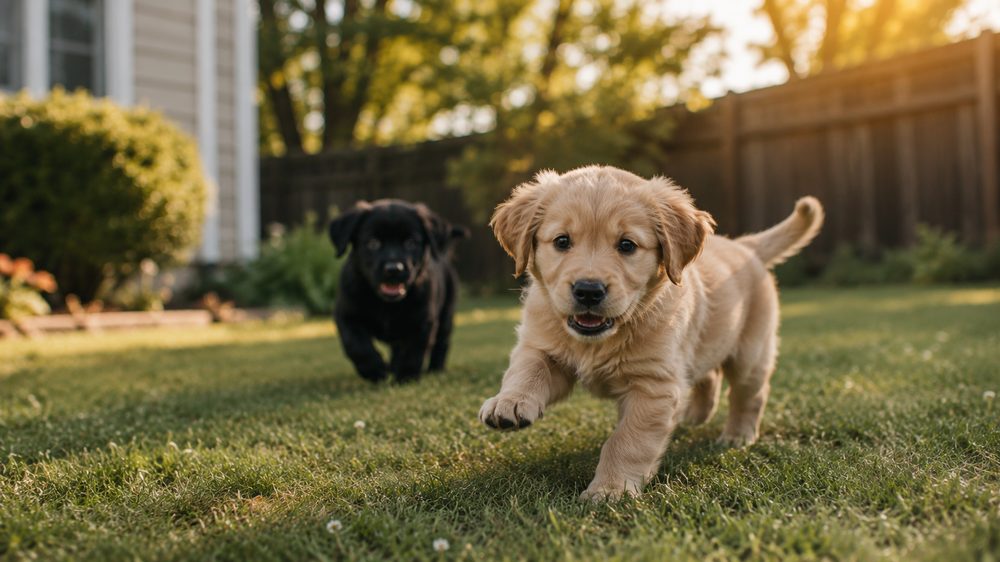
The internet sold you a montage of puppy snuggles. Nobody mentioned the 3 a.m. potty trips, the needle teeth, or the way a six-pound animal can dismantle your entire routine. Here's an honest, week-by-week map of the first month, so you know what's normal and what to do about it.
Before we start: lower your expectations (kindly)
The first 30 days are not when your puppy becomes a well-behaved dog. They're when your puppy learns that the world is safe, that you're trustworthy, and where the bathroom is. That's the whole job. If you measure success by obedience, you'll feel like you're failing. Measure it by safety, bonding, and slow potty progress, and you'll see how much is actually going right.
Week 1: Survival and safety
Your puppy just lost everything they knew - their mother, littermates, and the only home they'd experienced. The first week is about stability, not training. Keep the world small. One or two calm rooms, a consistent crate or pen, and a predictable rhythm of eat, potty, play, sleep, repeat.
Expect disrupted nights. Most young puppies can't hold their bladder through the night yet, so plan for one or two outings, kept boring and businesslike - out, potty, praise, back to bed, no party. Crying the first few nights is normal; a crate near your bed often helps the puppy settle, since proximity reassures them they're not alone.
Potty training starts now and runs on a simple truth: puppies can hold it roughly one hour per month of age, and they need to go after waking, after eating, after playing, and roughly every couple of hours otherwise. Take them out on a schedule, reward wildly when they go outside, and supervise relentlessly indoors. Accidents are management failures, not defiance.
Week 2: Routine and the first lessons
As your puppy settles, you can start layering in gentle structure. Their name, "come" as a happy game, and getting comfortable with the crate as a good place rather than a punishment. Keep training sessions absurdly short - two or three minutes - and end while it's still fun.
This is also when the famous needle teeth become a daily reality. Puppy biting is normal teething and play behavior, not aggression. Redirect to appropriate chew toys every time, and if a nip really lands, a brief "ouch" and a pause in play teaches bite inhibition. You're not stopping the chewing, you're aiming it.
Begin handling exercises too: touch the paws, peek in the ears, run your hands all over. You're banking trust now that pays off at every future vet and grooming visit.
Week 3: The socialization window is open
Here's the most time-sensitive thing in this entire article. The prime socialization window closes around 14 to 16 weeks, and what your puppy experiences during it shapes their adult temperament more than almost anything else. This is your chance to build a confident dog.
Socialization doesn't mean overwhelming your puppy. It means positive, controlled exposure to variety: different people, gentle sounds, new surfaces, car rides, the vacuum, an umbrella opening, calm and vaccinated friendly dogs. The goal is "huh, that's normal" not "that was terrifying." Keep every experience positive and let your puppy approach at their own pace - never force them toward something that scares them.
Talk to your vet about safely socializing before the full vaccine series is complete, since the behavioral risk of under-socializing is real too. Puppy classes designed for this stage are often a great structured option.
Week 4: Patterns emerge
By the fourth week, you'll start seeing the payoff. Potty accidents drop. Your puppy knows their name and comes running. The crate is becoming a chosen nap spot. You've got the beginnings of a rhythm, and your puppy is becoming a small individual with preferences and a personality.
This is also when the exhaustion can peak, weirdly, because the adrenaline of the new arrival fades and the grind sets in. That's normal. Lean on the routine. Consistency is doing more work than you can see.
A few things that'll save your sanity
Sleep is non-negotiable. Young puppies need 18 to 20 hours of sleep a day, and an overtired puppy looks exactly like a "hyper" or "bitey" puppy. When yours gets frantic, the answer is usually a nap, not more play. Enforce downtime.
Puppy-proof ruthlessly. Cords, shoes, toxic plants, small swallowable objects - assume everything within reach is a chew toy and act accordingly. A pen or gated area keeps your puppy safe when you can't have eyes on them.
Reward what you want. It's tempting to spend all day saying "no." Flip it. Catch your puppy doing something good - settling quietly, chewing the right toy, four paws on the floor - and reward it. You get more of what you reinforce.
Don't compare. Your neighbor's puppy who was "potty trained in a week" was either a fluke or a slight exaggeration. Development isn't a race.
The bottom line
The first 30 days are intense, occasionally miserable, and completely foundational. You're not building a perfectly trained dog yet - you're building a puppy who feels safe, trusts you, and is learning the shape of the world during the most important developmental window of their life. Protect their sleep, flood them with good experiences, keep potty trips on schedule, and forgive yourself the rough nights. It gets easier, and faster than you'd believe right now at 3 a.m.