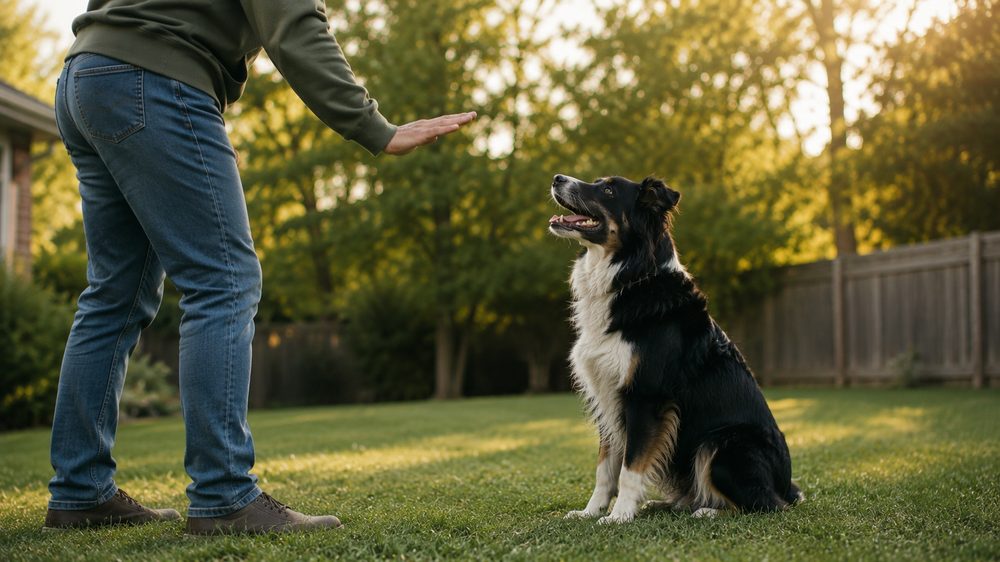
You open the door, your dog launches himself at your guest like a golden retriever seeing its human after a five-minute absence, and you are already saying sorry before anyone is even inside. Sound familiar?
Here is the thing. Your dog is not being rude, badly behaved, or dominant. He is being a dog who learned, probably years ago, that jumping up gets attention. Hands come down, voices go up, eyes land on him. From a dog point of view, that is a jackpot. He has been practicing a behavior that works, and guests have been helping him practice it every single visit.
The good news is that jumping is one of the most fixable everyday dog behavior issues, and you do not need to yell, knee anyone in the chest, or make the front door a stressful place to do it.
Why the Classic Fixes Usually Backfire
Let us talk about the knee-to-the-chest move. The idea is to make jumping uncomfortable enough that the dog stops. In practice, you are adding physical contact and a big reaction to an already exciting moment. For a lot of dogs, that just adds fuel. They do not read it as correction. They read it as engagement.
Shouting "off" has a similar problem. Your dog does not inherently know what "off" means, and a loud voice in a high-energy moment can either amp things up further or, in softer dogs, create anxiety around greetings. Neither outcome is what you are after.
Punishment-based approaches also share a bigger flaw. They tell the dog what not to do, but they do not tell him what to do instead. That gap is where good training lives.
What Actually Works: The Four Feet on the Floor Rule
The single most effective shift you can make is deciding, right now, that attention, eye contact, and any physical greeting only happen when four paws are on the floor. That is the rule. It sounds simple because it is, but the catch is consistency.
Every person in your household needs to be on the same page. If one person rewards the jump with a cuddle and another pushes the dog away, the dog learns that jumping is worth trying because it works sometimes. Variable rewards are actually very motivating, which means inconsistent responses make the habit harder to break, not easier.
Teaching the Alternative Before the Door Opens
The front door is not where training starts. It is where training gets tested.
Teach a solid sit or a go-to-your-mat behavior in calm moments, away from the excitement of arrivals. Once that behavior is reliable and fluent, you can start bringing it into greeting scenarios gradually.
Practice low-stakes versions of arrivals at home. Walk out your front door, wait thirty seconds, come back in. If your dog stays calm or offers a sit, reward generously. If he jumps, turn away, wait for four feet on the floor, then reward. Repeat. It feels repetitive because it is. That is how dogs learn.
If you have a willing helper, even better. Ask a friend or family member to stage practice arrivals. Give them the simple script: if the dog jumps, they turn away and wait. If the dog sits or keeps all four paws down, they say hello calmly and give attention. No big fuss, no high-pitched greetings, just quiet acknowledgment. Excited greetings at the door undo your work fast.
The One Sentence to Text Guests Before They Arrive
This one is underused and genuinely effective. Before a guest comes over, text them something like: "Can you ignore Biscuit until he has four paws on the floor? Even just a few seconds of turning away helps us a ton."
Most people are happy to help when they know what to do. The problem is usually that guests walk in, see an excited dog, and their instinct is to say hello. Giving them a concrete instruction removes the guesswork.
Using a Leash or Gate as a Training Aid, Not a Punishment
Management tools are not the same as training, but they are not failures either. They are how you set the situation up so your dog can actually succeed while you are still in the early stages.
A leash clipped to your belt or held loosely during greetings lets you guide your dog back to four feet if he starts to jump, without grabbing, shouting, or making it a big dramatic event. It simply limits the ability to rehearse the unwanted behavior while you are building the new one.
A baby gate across a hallway, or the dog behind a door for the first two minutes of a visit, is not giving up. It lets your guest get settled and your own energy come down, and then you bring the dog into a calmer environment. Greetings that happen when everyone is slightly less activated tend to go better.
What to Do About the Dog Who Only Jumps on Certain People
Some dogs are selective jumpers. Fine with most visitors, absolutely beside themselves for the one relative who screams "HI PUPPY" and crouches down at knee height.
This is not mysterious. Certain people consistently reward the behavior, either by giving exactly the kind of excited attention the dog loves, or by reacting in a way the dog finds interesting. The fix is the same as above, you just have to loop that specific person into the plan. Sometimes that conversation is awkward. Do it anyway. It is worth it.
The dog who jumps on children specifically often needs additional management while training is in progress. Kids move unpredictably, react loudly, and may not be able to follow the turn-away protocol reliably. Keep the dog on leash, give him an incompatible behavior to perform like sitting for a treat, and do not put either the child or the dog in a situation they are not ready for yet.
Patience Is the Unglamorous Part
If your dog has been jumping for two years, he will not stop in a week. That is not a reflection of his intelligence or your training. It is just math. Behaviors that have been reinforced many times take time and repetition to replace.
What speeds it up is consistency, management so he cannot keep rehearsing the old behavior, and making the alternative behavior genuinely rewarding. High-value treats, calm praise, real attention when four feet are on the floor. You are not bribing him. You are building a new habit.
Start before the next guest arrives. Practice your arrivals this week, text your next visitor that one sentence, and keep a handful of treats near the front door. The dog who sits calmly while you open the door is entirely possible. He just needs someone to show him what that looks like. 🐾
A Front-Door Plan for Calm Guest Greetings
Do not make the first real guest your training session. Rehearse with one helper while your dog is on leash and the house is quiet.
- Set a mat several feet from the door and reward your dog for standing or settling there.
- Have your helper knock once. If your dog leaves the mat, pause the arrival and reset.
- Open the door only while four paws remain on the floor.
- Let the guest enter without immediately touching or speaking to the dog.
- Release your dog for a brief greeting, then guide them back to the mat before excitement climbs.
Practice several short arrivals instead of one long visit. Consistency matters because jumping that earns attention even occasionally remains worth trying.