You turn your back for ten seconds. You come back and the chicken breast is gone. Your dog is on the other side of the kitchen looking completely innocent, and you're standing there wondering how this keeps happening.
Here's the short answer: because it works.
Counter surfing is one of the most persistent dog behaviors out there, and the reason is simple. Every time your dog noses the counter and finds food, they get paid. You don't even have to be in the room. The counter paid them, not you, and that's exactly why telling them off after the fact does absolutely nothing useful.
Let's fix it properly.
Why scolding does not work here
When your dog grabs something off the counter, the reward happens the moment they get the food. By the time you react, that transaction is already complete. Your dog is not connecting your frustration to the behavior. They're just learning that you get loud sometimes, which is stressful but unrelated to the counter.
Self-rewarding behaviors are durable. The more your dog successfully counter surfs, the stronger the habit becomes. Every successful raid is practice. So before we talk about training, we have to talk about management.
Step one: stop the practice before you train
Management is not a cheat. It is the first step.
If your dog keeps getting rewarded by the counter, training will crawl. You need to cut off access to the wins while you build the new skills. Practical management looks like this:
- Clear the counters. Nothing within nose reach while you are training. If your dog can jump, that means everything. A roast sitting on the edge of the stove is not a test of training, it is an invitation.
- Use baby gates or exercise pens to keep your dog out of the kitchen during meal prep and cleanup. This is not forever. This is while you teach.
- Don't leave your dog unsupervised in the kitchen with food out. Not yet.
The coffee table with the chips on it is the same problem as the kitchen counter. The trash can your dog raids is the same problem. Treat all of them the same way. If the surface can pay, it needs to be managed until training is solid.
Step two: teach leave it as a real skill
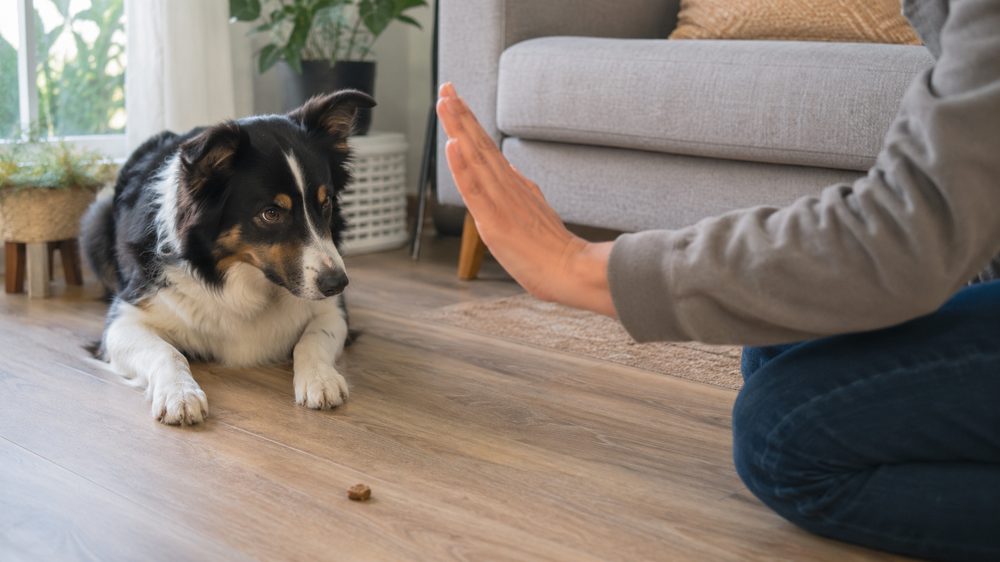
Leave it is not a correction you shout when your dog is already committed. It is a trained response, and it takes real practice to build.
A dog who has a solid leave it understands that ignoring something on cue means good things happen. That is a very different thing from a dog who has been yelled at near the counter. Build it in low-distraction environments first, then proof it near the kitchen, then near actual counters with food present and you managing the outcome.
Don't call it a win until your dog can leave food on a low surface while you are standing nearby. That takes time.
Step three: build an alternative behavior
Leave it tells your dog what not to do. An alternative tells them what to do instead.
The most useful one for counter surfing is a solid go to your mat or go to your place cue. The goal is that when food is being prepared, your dog has somewhere specific to be that is away from the counter, and being there is rewarding.
How to build it: start by rewarding your dog heavily just for being on the mat while you are in the kitchen. No food on the counter yet. Just you moving around and them staying put and getting good things for it. Build duration slowly. Add the distraction of food prep gradually once the mat behavior is reliable.
Eventually your dog should drift to their mat when you start cooking, because that spot has become the most reliably rewarding place in the kitchen to be.
Step four: what to do when you catch them mid-reach
This happens. Here is what to actually do.
Say your leave it cue calmly, once, if you have been training it. Then redirect your dog to their mat or ask for a sit and reward that. Remove the opportunity. Don't chase, grab, or make a big scene. Drama makes the behavior more exciting, not less.
If you have not trained leave it yet, simply interrupt the behavior calmly, remove the food, and take it as a reminder that management needs tightening before training can do its job.
Boredom vs opportunity: two different dogs
Some dogs counter surf because they are under-stimulated and the kitchen smells interesting. Some dogs counter surf because they learned early on that it pays and the habit is baked in.
If your dog raids counters when you are not home, even after exercise and engagement, that is a trained habit from past wins. Management and consistent training will address it, but it will take longer.
If your dog counter surfs mostly when under-exercised or understimulated, ramping up their physical and mental enrichment will take pressure off the kitchen. Training still matters, but a tired, mentally satisfied dog is less motivated to go hunting.
How long does this realistically take?
Honest answer: it depends on how long the behavior has been paying off.
If you catch a puppy after two or three successful raids, a few weeks of solid management and training will get you a long way.
If you have a four-year-old dog who has been surfing counters successfully their whole life, you are looking at months of consistent work before you can meaningfully reduce management.
The rule of thumb: you can start to fade management when your dog is reliably going to their mat during food prep and has not had a successful counter surf in several weeks. Don't rush it. If they get a win because you relaxed management too early, that one win can refresh the habit significantly.
Fade slowly. First try leaving one boring item on the counter while you are in the room and watching. See how they respond. Build from there.
The bottom line
Counter surfing is not a dominance thing, a stubborn dog thing, or a moral failing. It is a dog doing what has worked. Your job is to make the counter reliably boring and make something else reliably great.
Manage first so the counter stops paying. Train leave it as an actual skill. Build a mat behavior that gives your dog somewhere to be. And stay consistent, because one unattended sandwich can set you back a week.
You can do this. Your dog is not trying to make your life hard. They are just very, very good at finding free food. 🐾