You did the work. You taught leave it. Your dog knows it too, right up until they find something far more interesting than you, clamp it in their jaws, and bolt. Now you're jogging across the yard in your socks, making the whole thing look like the best game ever invented.
Here's the thing: leave it and drop it are not the same command with different words. They are two completely separate tools for two completely different moments. Knowing which one to use, and how to teach it properly, is the difference between a dog who spits out the dead bird and a dog who treats your panic as an invitation to run faster.
Let's sort it out.
The real difference between drop it and leave it
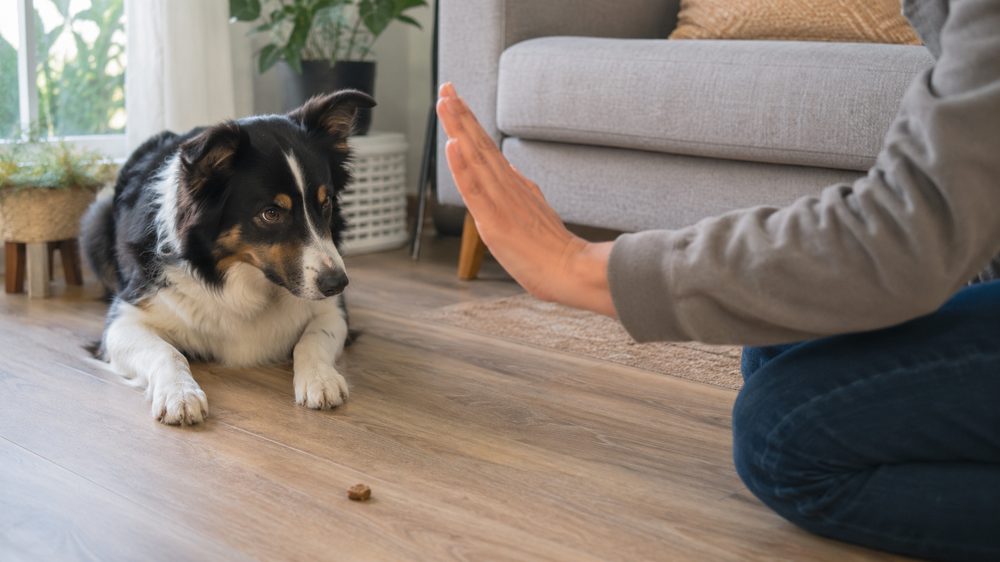
Leave it means: do not touch that, do not pick it up, walk away. It works before anything reaches the mouth. It is a prevention tool.
Drop it means: you already have that in your mouth, please release it now. It is a recovery tool.
If your dog already has something, leave it is useless. The moment has passed. Drop it is the cue you need, and if you never trained it properly, you are going to lose that standoff every single time.
Why chasing makes everything worse
Before the training steps, this part matters a lot. When a dog picks something up and you run at them, reach for the item, or start prying at their mouth, you are teaching them that holding the thing gets them your full, frantic attention. That is a reward. For some dogs, the grabbing and prying also teaches them to hold on harder and guard more intensely, which is a pattern you genuinely do not want to create.
If your dog shows serious guarding behavior, growling over objects, stiffening, or snapping, that is a conversation for a professional trainer or behaviorist, not a blog post. But for the everyday dog who just runs because it is fun, the trade method is your answer.
How to teach drop it using a trade
The core idea is simple. You offer something of equal or better value in exchange for what the dog has. The dog learns that dropping an item does not mean losing everything. It often means getting something better. Over time, the word drop it starts to predict that good trade, and the dog responds to the cue before you even produce the treat.
- Step one. Start with something your dog likes but is not obsessed with. A lower-value toy works well here. Let them take it and hold it.
- Step two. Produce a high-value treat, something genuinely exciting, and hold it near their nose. Most dogs will open their mouth immediately to go for the treat. The moment the toy drops, say drop it clearly and give the treat. Pick the toy back up calmly and offer it again. Repeat.
- Step three. Start saying drop it a half second before you show the treat, so the word starts to carry meaning on its own.
- Step four. Practice with slightly higher-value items over several sessions. Work up gradually. A favorite toy. A chew. A stolen sock. You are building a track record of fair trades so the dog trusts the deal.
- Step five. When a real-world moment happens on a walk, use the cue calmly, produce your treat, and trade. No chasing, no drama. The dog spits it out, gets rewarded, and you quietly pick up the disgusting thing while pretending to be fine.
A note on the toy: always give the item back sometimes, or use a different reward entirely. If the dog learns that drop it always means you take the thing permanently, they will start running before you get close. Vary the outcome so the cue stays worth responding to.
Common mistakes to avoid
- Reaching for the item before the dog releases it. This triggers the instinct to hold on tighter. Wait for the drop, then pick it up.
- Using leave it when the item is already in the mouth. Wrong tool, wrong moment. Save your energy for drop it.
- Only practicing when something bad is happening. If the only time you say drop it is during a crisis, the cue will carry a stressful charge. Practice it as a fun, low-stakes game several times a week so it stays positive.
- Trading down. If your dog has a piece of chicken they found on the sidewalk and you offer a piece of dry kibble, that is not a fair trade and they know it. Carry something genuinely good when you walk.
- Chasing, ever. Even once. It reinforces exactly the behavior you are trying to stop.
Building up to real-world reliability
The practice ladder for puppy obedience training and adult dogs looks the same. You move from easy to hard in small steps.
Start indoors with a boring toy. Then a favorite toy. Then a chew. Then practice in the backyard where there are mild distractions. Then on a quiet sidewalk. Then in a park with other smells and people around. Each environment is a new challenge because a dog does not automatically transfer a behavior from one place to another. They need reps in different places before the cue is genuinely reliable.
For puppies especially, keep sessions short, around two to three minutes, and always end on a success. If your puppy is struggling, make the item less valuable and build back up. Slow progress is real progress.
What about leave it? Where does that fit now?
Leave it still has an important role. It is the cue that stops your dog before they pick up the chicken bone on the sidewalk. Drop it is what you use if they beat you to it. You need both, and they work as a team.
A solid dog training commands toolkit includes both cues taught clearly, practiced regularly, and kept positive. Neither one should only appear when something has already gone wrong.
The bottom line
If you have been chasing your dog around the yard, the issue is not that your dog is defiant. It is that drop it was never properly trained, or the trade was never good enough to be worth their while. Fix the trade, build the habit in low-stakes practice, and the panicked sprinting across the yard becomes a thing of the past.
Start tonight with a toy they like but will not die for, your best treats, and about three minutes of your time. That is genuinely all it takes to begin. 🐾