Your dog sees the towel. Their eyes go wide. They are already behind the couch.
Bath time in a lot of households looks less like grooming and more like a hostage negotiation. You are soaked, the dog is offended, and somehow the bathroom wall got involved.
Here is the thing: it does not have to go that way. A calm, repeatable routine changes everything. Once you understand a few basics about how often dogs actually need bathing, how to prep the space, and how to brush for your dog's specific coat type, the whole thing gets a lot less dramatic.
How Often Does Your Dog Actually Need a Bath
Less often than you think. Most dogs do well with a bath every four to six weeks. Some short-coated dogs who spend most of their time indoors can go longer. Dogs with skin conditions or allergies may need more frequent washing with a medicated shampoo, but that is a conversation for your vet.
Over-bathing is a real thing. Washing too frequently strips the natural oils from your dog's coat and skin, leaving them dry, flaky, and itchy. If your dog's coat looks dull or their skin seems irritated after baths, bathing less often is usually the first thing worth trying.
Post-swim is an exception. Rinse your dog after lake or ocean swims to get the bacteria, algae, and salt out, but a full shampoo wash every time is not necessary.
Choosing the Right Shampoo
Use a shampoo made for dogs. Human shampoo, even baby shampoo, has a different pH than what a dog's skin needs and can cause irritation over time.
Look for a shampoo with a short, readable ingredient list. Oatmeal-based formulas work well for sensitive or dry skin. Avoid anything with artificial fragrances if your dog already shows signs of skin sensitivity. Whitening or brightening shampoos are fine for light-coated dogs but are not necessary for anyone.
If your dog has a diagnosed skin condition, ask your vet before choosing a shampoo. Some medicated options require a prescription.
Setting Up the Space Before Your Dog Walks In
This step is underrated. A panicked dog is often reacting to chaos, not just water. A few minutes of prep makes a real difference.
- Put a non-slip mat in the tub or use a folded towel. Cold tub floors are slippery and uncomfortable, and a dog who cannot get traction is going to struggle.
- Get the water temperature right before your dog is in it. Aim for lukewarm, around 100 to 102 degrees Fahrenheit. That is warm to your wrist, not hot. Dogs are more sensitive to water temperature than most owners realize.
- Have everything within arm's reach before you start: shampoo, a cup or detachable sprayer for rinsing, and towels. Leaving a wet dog to go find something is how bathrooms get redecorated.
The Desensitization Sequence for Water-Shy Dogs
If your dog bolts at the sound of running water, you are not going to fix that in one bath. You work backward from the problem.
- Start with just being in the bathroom together. No water, no bath. Treats, calm voice, good association. Do that a few times over a few days.
- Next session: water running in the tub, dog in the room, no getting in. More treats.
- Then a paw in the tub. Then standing in an empty tub. Then a little water.
You build the picture slowly, and each step gets rewarded. It takes patience upfront but saves you a fight every single bath for the next decade.
For dogs who are genuinely panicked, not just reluctant, talk to your vet. Anxiety around grooming is a real issue and there are options beyond just pushing through it.
Brushing Before the Bath: Why It Actually Matters
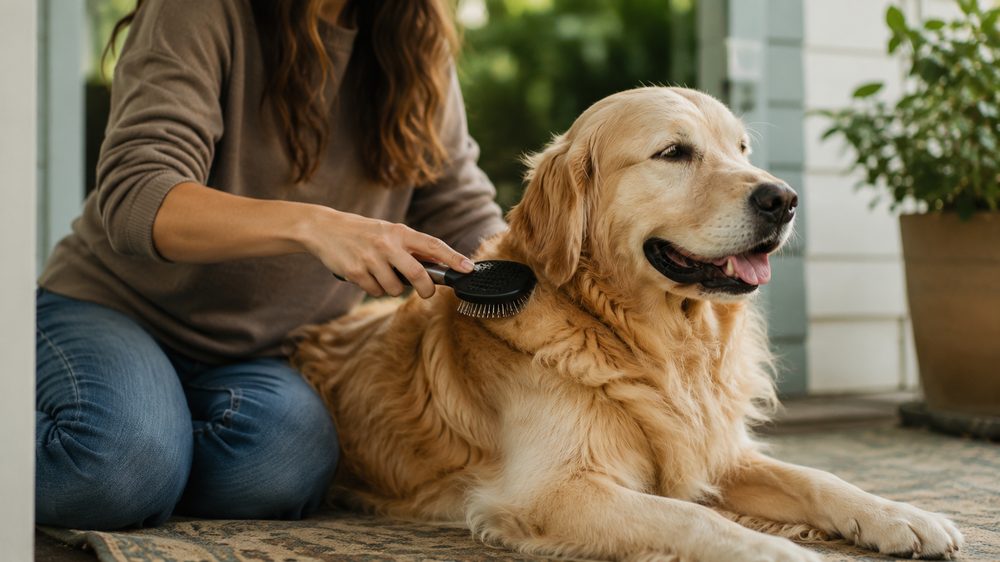
Brush first, always. Wetting a coat that has tangles in it sets those tangles permanently. What was brushable becomes a mat that needs cutting out.
Brushing technique depends on coat type.
- Double coats (huskies, golden retrievers, labs). Use an undercoat rake or slicker brush and work in sections. In shedding season, expect a lot of fur. Brush against the growth direction first to loosen the undercoat, then with the growth to smooth. These dogs blow their coats twice a year, and brushing regularly prevents the worst of it ending up on your furniture.
- Curly coats (poodles, doodles). Use a slicker brush and a metal comb. Work through small sections and always comb through after the brush to check for knots hiding underneath. Curly coats mat faster than any other type.
- Short, smooth coats (beagles, boxers, dalmatians). A rubber curry brush or grooming mitt is all you need. These coats shed more than they look like they should. Short strokes in the direction of growth.
- Wire coats (terriers, schnauzers). A slicker brush plus a stripping comb if you want to maintain texture. Wire coats can look fine on top while hiding undercoat buildup underneath, so brush through fully.
How to Work Out Mats Without Hurting Your Dog
Small mats caught early can be worked out with your fingers and a detangling spray, then combed through gently. Hold the mat at the base, close to the skin, so you are not pulling the skin while you work through it.
Bigger mats need to be split first. Use a mat splitter or blunt-ended scissors to divide the mat into smaller sections, then work each one out separately. Never try to brush through a large mat in one pass. It hurts, the dog learns to hate brushing, and it makes the next session harder.
If a mat is tight against the skin, feels like it is pulling when the dog moves, or is in a sensitive area like behind the ears or in the armpit, that is the line where a professional groomer should take over. Some mats need to be shaved out, and trying to force them free can cause brush burn or skin tearing.
The Step-by-Step Bath
Once your dog is brushed and the space is set up, the bath itself is straightforward.
- Wet the coat fully before applying shampoo. Start from the neck and work back. Keep water and shampoo away from eyes and ears. A cotton ball placed gently in each ear during the bath can help prevent water getting in, but never push it in deeply.
- Work the shampoo through the coat down to the skin, then rinse completely. Shampoo left in the coat causes irritation, and that flaky itchy skin owners sometimes blame on the product is often just incomplete rinsing. Rinse until the water runs clear, then rinse once more.
- Towel dry first, blotting rather than rubbing for curly and double coats. A dog-specific dryer or a regular blow dryer on the lowest heat setting works for thicker coats. Keep the dryer moving and hold it at least six inches from the skin.
- Brush through once more while drying to prevent new tangles forming as the coat sets.
Your At-Home Grooming Checklist
- Before the bath: non-slip mat in, water temperature tested, shampoo and towels ready, dog brushed out fully.
- During the bath: wet coat thoroughly before shampooing, avoid ears and eyes, rinse until the water runs completely clear.
- After the bath: towel blot first, blow dry on low heat if needed, brush through while drying.
- When to call a professional groomer or vet: mats tight to the skin, signs of skin infection, extreme anxiety that treats and slow desensitization are not helping, or any coat that is getting away from you faster than you can manage it.
The Bottom Line
A bath that does not turn into a wrestling match is mostly about preparation. Right temperature, right tools, dog brushed first, space set up before anyone gets wet, and a dog who has learned that grooming ends in treats rather than trauma.
It takes a few calm sessions to build the routine. Once it is built, it stays built. And your bathroom wall will thank you. 🐾